
The Australian property landscape is undergoing a notable transformation. After years defined by soaring prices, rapid auctions, and intense buyer competition, momentum in major markets across the country has shifted.
We are officially stepping into a Buyer’s Market.
For homebuyers, upsizers, and property investors, this shift represents one of the best windows of opportunity in recent years. Understanding how market dynamics have changed—and how to align your home loan strategy accordingly—can help you secure property on far more favorable terms.
What is a Buyer’s Market vs. a Seller’s Market?
To take advantage of current property trends, it helps to understand the underlying mechanics of how supply and demand dictate market conditions.
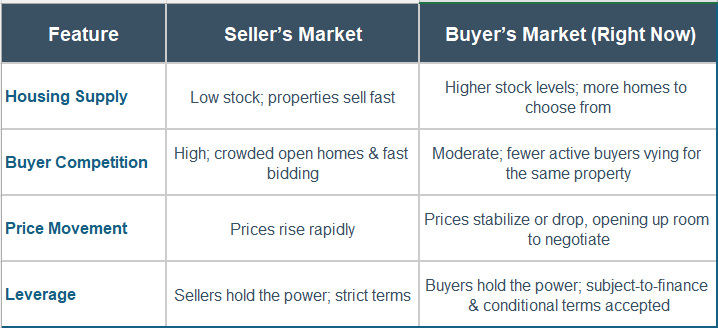
Seller’s Market (What We Came From)
In a seller’s market, buyer demand outpaces available housing supply. Properties sell quickly, often well above listing prices or reserve figures at auction.
-
- Leverage: Sits almost entirely with the vendor.
-
- Buyer Experience: Fast-paced, stressful, with minimal room for price negotiation or conditional offers (such as subject-to-finance or subject-to-building inspections).
Buyer’s Market (Where We Are Now)
A buyer’s market occurs when housing inventory rises or buyer demand tempers, giving purchasers more choices and increased control over the transaction.
-
- Leverage: Sits with the buyer.
-
- Buyer Experience: Less competition, longer days on market for properties, and genuine room to negotiate price and settlement terms.
Which Australian States and Markets Are Seeing Price Adjustments?
The shift toward a buyer’s market is visible in key capital cities and regional centers across Australia, with performance varying by location:
-
- New South Wales (Sydney & Regional NSW): Sydney and surrounding regional markets have led the correction, with detached house values easing. High interest rates and affordability caps have moderated buyer urgency, creating excellent conditions for buyers seeking discounts off peak pricing.
-
- Victoria (Melbourne & Regional VIC): Melbourne continues to offer some of the most buyer-friendly conditions in the country. Increased housing inventory and property tax adjustments have slowed price growth, leaving sellers much more open to conditional offers and price reductions.
-
- Australian Capital Territory (Canberra): Canberra has similarly seen property values cool, offering prospective buyers broader choice and less auction pressure.
-
- Queensland, Western Australia, & South Australia (Brisbane, Perth, Adelaide): While these markets experienced strong momentum in recent years, growth rates have slowed down considerably. Buyers in Brisbane, Perth, and Adelaide are finding fewer frantic bidding wars and more room to negotiate sensible purchase prices.
Key Benefits of Buying in Today’s Market
For buyers positioned to take action, a cooling market offers several distinct financial and lifestyle advantages:
A. Real Price Negotiation
In a buyer’s market, vendors can no longer count on multiple competing offers pushing prices above expectations. Buyers can submit realistic offers below asking prices, request repairs, or ask for vendor concessions without fear of immediately being priced out.
B. Favorable Contract Terms
During peak seller markets, buyers are often forced to make unconditional offers to stay competitive. In today’s market, sellers are far more willing to accept standard protective clauses, including:
-
- Subject to Finance clauses (giving your broker time to formalize loan approval).
-
- Subject to Building & Pest Inspections.
-
- Flexible Settlement Periods (30, 60, or 90+ days depending on your needs).
C. The “Upgrader’s Advantage”
If you already own a home and want to upgrade to a larger property or a better location, a market dip works strongly in your favor.
Example: If the market drops by 5%, a home you own worth $800,000 might lose $40,000 in nominal value. However, the $1.4 million home you want to purchase drops by $70,000. Overall, the net gap between your sale and purchase shrinks by $30,000, making your upgrade significantly cheaper.
How to Capitalize: The Role of Pre-Approval and Smart Lending
While market conditions favor buyers, lending requirements and interest rate settings mean borrowing capacity must be carefully calculated. Lenders continuously update their serviceability buffers and credit policies.
To make the most of a buyer’s market, structure your finance before you start making offers:
-
- Secure Fully Assessed Pre-Approval: Knowing your exact borrowing ceiling allows you to make confident, binding offers quickly when a seller is ready to negotiate.
-
- Explore Specialised Lending Options: Depending on your situation—whether you are utilizing first-home buyer deposit schemes, borrowing through a family trust, or leveraging equity from an existing home—choosing the right lender structure can maximize your borrowing power.
-
- Lock in Your Rate Strategy: Your mortgage broker can review fixed vs. variable options to protect your cash flow while keeping your loan structure flexible for future investment.
Ready to Turn Market Conditions into Your Advantage?
A buyer’s market doesn’t last forever. As interest rate cycles stabilise and housing demand rebuilds, these favorable buying conditions will eventually shift again. Whether you’re looking to purchase your first home, upgrade your family property, or expand an investment portfolio, getting your finance structured correctly is your first step.
Contact our team today for a complimentary borrowing capacity review and pre-approval assessment. Let’s make sure you’re ready to negotiate with confidence.
August 2026
