On 3 November 2026, the Reserve Bank of Australia (RBA) raised the official cash rate by 0.25% to 4.85%—its fifth 0.25% hike of 2026. After cuts in 2025 brought the cash rate down to 3.60%, rate rises in February, March, May, September, and November have lifted it by 1.25 percentage points in 2026 alone, driven by sticky inflation, global fuel and supply pressures, and domestic capacity constraints.
Most lenders pass these increases on to variable home loans. If you have a variable mortgage, expect your repayments to climb—and with inflation still sitting above the RBA’s 2–3% target range, borrowers need a plan in case rates stay higher for longer or move again.
How Much Extra Interest Does a 0.25% Rise Add?
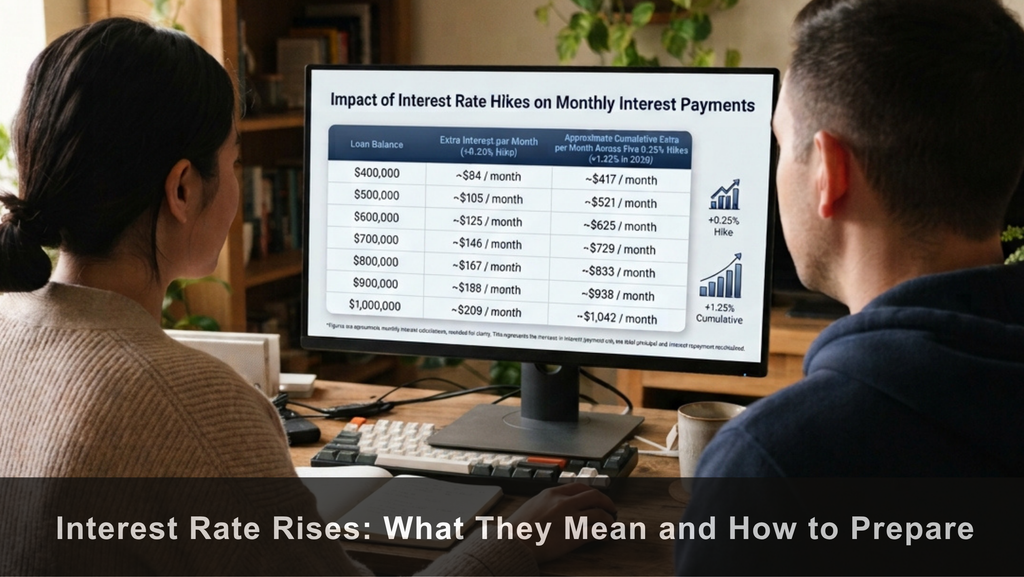
A 0.25% rate rise adds roughly $21 per month in interest for every $100,000 borrowed. Across five 0.25% moves in 2026 (+1.25% total), the cumulative pressure adds up quickly—even before accounting for principal repayments. Below is some examples on how much extra you would be paying
On a $600,000 mortgage 0.25% increase means approx. $125 extra interest per month, and for 1.25% increase that is around $625 extra interest per month.
On a $1,000,000 mortgage 0.25% increase means approx. $209 extra interest per month and for 1.25% increase that is around $1042 extra interest per month.
Refer to picture above to understand how much each rate rise of 0.25% and total of 5 rate rises i.e., 1.25% financially impacts you.
How to Prepare for Higher Rates in 2026 and beyond
When borrowing costs rise alongside everyday living expenses, small leaks in your budget matter more. Review your regular bills—such as electricity, gas, internet, insurance, groceries, and unused subscriptions—and shop around for sharper deals.
We suggest you have a look at your last 3 month bank statements and see what you can cut down and which bills you can negotiate with the provider or look around for better deals. Recently one of our client after review stopped around 3 online unused subscriptions savings them around $80/month, another client saved around $650 per annum after changing car and home insurance to different provider. Please remembers small amounts do add up.
- Build a Buffer and Pay Extra When You Can
Even modest extra repayments can cut years off a loan and reduce the interest charged over time. For example, on a $500,000 loan at 6.00% over 30 years, repayments are roughly $3,000/month. Adding an extra $100/week on top of your repayments could shave around 8 years off the loan term (bringing it down to roughly 22 years).
In a higher-rate environment like late 2026, also consider keeping a cash buffer so a rate change, utility spike, or car/fuel bill doesn’t force you onto high-interest credit.
- Use an Offset Account or Redraw Facility Smartly
Both offset accounts and redraw facilities help reduce the interest you pay, though they work differently:
Offset Account: A separate everyday transaction account linked to your home loan. Because interest is calculated daily and charged monthly, money sitting in your offset reduces the loan balance you pay interest on (for instance, a $600,000 loan with $40,000 in offset is charged interest on $560,000). You can deposit and withdraw funds freely.
Redraw Facility: Lets you put extra repayments directly onto your home loan to lower interest charges, while allowing you to redraw those extra funds later for major costs like renovations or emergencies (subject to lender rules and limits).
- Check Your Borrowing Power Before Making Big Moves
Borrowing power (or borrowing capacity) is the maximum amount a lender will offer based on your income, expenses, existing debts, and interest rate buffers. Higher interest rates reduce how much you can borrow.
For example, if you could borrow up to $700,000 with a repayment around $4,311/month, a 0.25% rate increase pushes repayments up by roughly $114/month (to about $4,425/month)—and five 0.25% hikes in 2026 have a much larger impact on serviceability. If you’re planning to buy, upgrade, or refinance, check your updated borrowing capacity early.
- Review Your Rate and Speak With Us
Rate decisions by the RBA are outside our control, but staying proactive puts you in a stronger position. At Draw Equity, we help borrowers stay on top of their loans by comparing interest rates, features, and fees across a wide panel of Australian lenders to see if you can get a sharper deal or structure your loan more effectively.
If you—or your friends and family—want to review your current mortgage rate, offset setup, or borrowing options, reach out directly and we’ll be glad to help.
